Ten Publications in which USRC Naugatuck is Mentioned

1) Appletons' Annual Cyclopaedia and Register of Important Events of the Year 1867. Embracing Political, Military, and Ecclesiastical Affairs; Public Documents; Biography, Statistics, Commerce, Finance, Literature, Science, Agriculture, and Mechanical Industry. Third Series, Vol. II. Whole Series, Vol. XXXVII by Anonymous.
George Washington, on page 710 of the second volume of the third series of Appletons' Annual Cyclopaedia and Register of Important Events of the Year 1867, is reported to have founded the Revenue-cutter Service of the United States of America in the closing decade of the eighteenth-century. Alexander Hamilton, who is described as the first Secretary of the Treasury of the United States of America, is claimed to have persuaded Washington of the necessity of establishing a Revenue-cutter Service for the fledgling Republic. It is reported that the Revenue-cutter Service, which is claimed to have been organized in a similar manner to that of the military, had participated in the earliest wars that embroiled the United States of America. USRC Naugatuck, during the siege of Fort Darling, is identified as one of the ironclads that engaged the batteries which the Confederate States Army had installed on the bluff that overlooked the James River. It is reported, on page 713, that the Revenue-cutter Service was the oldest maritime organization in the United States of America. Confusion may arise, however, about whether the Revenue-cutter Service was a civilian or a military organization. It is claimed that the Revenue Marine, as the Revenue-cutter Service was also known, was a civil institution that could be called upon to fulfil a military role. Steam-engines, during the first year of the American Civil War, are reported to have been installed on the fighting vessels that belonged to the Treasury Department. A corps of engineers, which is claimed to have arisen as a consequence of the revenue-cutters relying upon steam-engines as their principle means of locomotion, is reported to have been incorporated into the Revenue-cutter Service. USRC Naugatuck, which had arrived at the time in which the fighting vessels of the Revenue Marine were undergoing a transition from sail-power to steam-power, could be regarded as a part of the effort that the maritime organization was making to modernize its fleet.
2) Chronicles of the Great Rebellion against the United States of America. Being a Concise Record and Digest of the Events Connected with the Struggle-Civil, Political, Military and Naval- with the Dates, Victories, Losses and Results-Embracing the Period between April 23, 1860, and October 31, 1865. by Various Authors.
It is reported, on page 24 of Chronicles of the Great Rebellion against the United States of America, that a detachment of the Confederate States Navy was able to capture three small transport vessels that were flying the Flag of the United States of America. CSS Merrimac, CSS Henry and CSS Jefferson are identified as the fighting vessels that conducted the raid while several unnamed tugs are claimed to have been present during the engagement. On the 11th of April, 1862, CSS Merrimac is reported to have departed from Norfolk with its consorts and prizes are claimed to have been captured on the same day. USS Monitor and USRC Naugatuck, who are reported to have engaged CSS Merrimack as well as its consorts from a distance, appear to have been unable to prevent the capture of the ships. It is claimed, on page 27, that USRC Naugatuck was involved in an attack on the battery that the Confederate States Army had installed at Sewall's Point. On the 8th of May, 1862, six Federal gunboats are reported to have participated in an armed reconnaissance mission that sought to test the strength of the battery. USRC Naugatuck, USS Dacotah, USS Monitor, USS San Jacinto, USS Seminole and USS Susquehanna are identified as the fighting vessels that participated in the engagement. It is reported that the United States Army, who are claimed to have installed a battery at the Rip-raps, assisted the United States Navy during the battle. CSS Merrimac, on the 8th of May, is reported to have exchanged fire with the Federal gunboats. It is claimed, on page 28, that USRC Naugatuck was one of three ironclads that participated in the Battle of Drury's Bluff. On the 15th of May, 1862, five Federal gunboats are reported to have engaged the battery that the Confederate States Army had established on a raised bank of the James River. It is reported that the 100-pounder Parrott rifle that formed the main armament of the Stevens Battery, as USRC Naugatuck was also known, burst during the battle.
3) Engineering: An Illustrated Weekly Journal. Vol. XVIII.-From July to September, 1874. edited by W. H. Maw and J. Dredge.
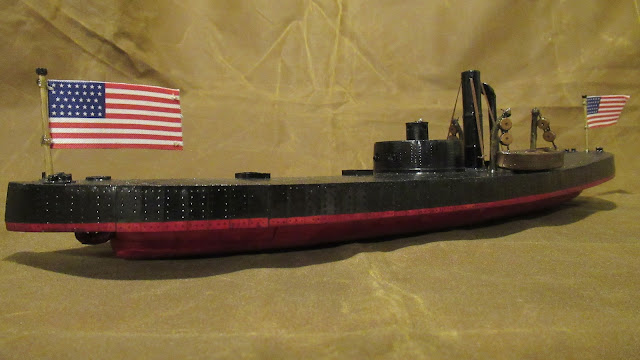
Professor Robert Henry Thurston, whose article about the Stevens family is included in the the eighteenth volume of Engineering: An Illustrated Weekly Journal, describes Colonel John Stevens as the greatest engineer and naval architect to live at the beginning of the nineteenth-century. Robert L. Stevens, who is identified as the son of John Stevens, is claimed to have assisted his father in the introduction of steam-navigation on the Delaware River and on the Connecticut River. It is reported, on page 427, that Robert L. Stevens attempted to built a war-steamer for the government of the United States of America. Stevens is claimed to have intended his man-of-war, whose keel is reported to have been laid in 1842, to be impervious to shot and shell. James C. Stevens and Edwin A. Stevens, who are identified as the sons of John Stevens, are claimed to have assisted Robert L. Stevens in the construction of his ironclad. It is reported that the original Stevens Battery, in 1854, was abandoned and it is claimed that work was commenced on a second ironclad. Robert L. Stevens, however, is reported to have passed away before the second project was completed. USRC Naugatuck, whose guns are claimed to have been worked by steam, is reported to have been built to demonstrate the design principles of the second ironclad that Robert L. Stevens had designed. It is stated that the ironclad, whose breadth of beam is reported to have been twenty-feet and whose depth of hull is claimed to have been seven-feet, was 100-feet in length. Ballast tanks, which permitted the ingress or egress of water, are reported to have allowed the ship to be sunk to fighting depth. William W. Shippen is claimed to have commanded the ironclad, which is reported to have operated on the James River, while it was engaging the armed forces that were defending Richmond. It is claimed that the gunboat, until its Parrott rifle burst, rendered useful assistance to the armed forces of the United States of America as they ascended the James River.
4) Memorial of Alexander Lyman Holley, C.E. LL.D. President of the American Institute of Mining Engineers, Vice-president of the American Society of Civil Engineers, Vice-president of the American Society of Mechanical Engineers, Member of the Institution of Civil Engineers, and of the Iron and Steel Institute of Great Britain, Etc., Etc. Born July 20, 1832. Died January 29, 1882. by the American Institute of Mining Engineers.
Edwin A. Stevens and Robert L. Stevens, on page 128 of Memorial of Alexander Lyman Holley, are claimed to have been responsible for many of the improvements in modern warfare. Colonel John Stevens, who is identified as the father of the Stevens brothers, is reported to have introduced the use of marine screws as a means of propelling steam-powered vessels. It is reported that the Stevens Battery and USRC Naugatuck, in addition to various fighting vessels of the Royal Navy, were propelled by twin screws. Edwin A. Stevens, during the American Civil War, is reported to have presented USRC Naugatuck to the Treasury Department of the United States of America. John Stevens, who is claimed to have designed his twin-screw arrangement in 1805, is credited with introducing the concept of propelling warships with double propellers to the naval architects of the nineteenth-century. Edwin A. Stevens and Robert L. Stevens, whose father is portrayed as an innovator as well as a visionary, appear to transformed the concepts of their progenitor into a practical reality. It it reported that work on the Stevens Battery, whose construction is claimed to have been proposed to the Federal government in 1841, did not commence until 1854 and it is explained that the ironclad had not been completed by the opening year of the War of the Rebellion. Funding for the construction of the ironclad, which is reported to have included half a million dollars worth of public appropriations, is claimed to have been insufficient to complete the construction project. Edwin A. Stevens is reported to have spent $200,000 of his own money on the ironclad. It is reported, on page 129, that a request for an additional half-a-million dollars worth of public appropriations was rejected by Congress. Gifting USRC Naugatuck to the Treasury Department, therefore, may be interpreted as an attempt to secure public funding for the construction of the larger ironclad that Robert L. Stevens had commenced building in the previous decade.
5) Scientific American: An Illustrated Journal of Art, Science & Mechanics. Volume VI. New Series.
USRC Naugatuck, on page 202 of the sixth volume of the new series of Scientific American, is described as a small ironclad gunboat that the Stevens family had converted from a canal boat. Hoboken is named as the town from which the Stevens family conducted their business while Bordentown, which is reported to have been located in the State of New Jersey, is identified as the place in which the Stevens dynasty constructed the man-of-war. No information is provided about which branch of the government of the United States of America, who are named as the intended recipients of the iron-plated gunboat, would receive the ironclad. Technical features of the iron-cased fighting vessel, which is claimed to have been powered by a steam-engine and propelled by marine screws, are reported to have included the presence of water-tight partitions which allowed the depth of the hull to be altered. It is claimed that the ironclad, whose dimensions are reported to have been identical to those of a typical canal boat, could be submerged to a fighting depth of seven and a half feet. Water, which filled the ballast tanks which are reported to have been situated at the opposing ends of the gunboat, is claimed to have sunk the man-of-war to its fighting depth. It is reported that the man-of-war, whose bunkers are claimed to have carried enough coal for twelve days of consumption, could travel at a speed of seven knots-per-hour. USRC Naugatuck, on page 371, is claimed to have lost the use of its 100-pounder Parrott rifle during an engagement that occurred on the James River. None of the mariners that served onboard the gunboat, who are reported to have been situated below the decks at the time in which the gun exploded, are claimed to have been injured during the accident. It is is reported that the crew of the ironclad, which is claimed to have consisted of thirty mariners who were hidden below the deck of their ship, were protected from the shockwave and flying debris that the bursting rifle produced.
6) Southern Historical Society Papers. Volume XI. January to December, 1883. by Various Authors.
Hardin Beverley Littlepage, whose account of the military operations that occurred in the State of Virginia is included in the eleventh volume of Southern Historical Society Papers, describes the aftermath of the Battle of Hampton Roads. Information about the circumstances in which CSS Merrimack was scuttled can be found on pages 32, 33 and 34 of the collection of articles. On the 8th of May, 1862, the United States Navy is reported to have sent three ironclads and five unprotected men-of-war to engage the batteries that the Confederate States Army had established at Sewell's Point. USS Galena, USS Monitor and USRC Naugatuck are identified as the ironclads that engaged the batteries on the 8th of May. Littlepage, who is claimed to have served as a Midshipman onboard CSS Merrimack, claims that the Confederate States Navy made an unsuccessful attempt to engage the Federal warships that were bombarding Sewell's Point. It is reported that the Federal warships, during the engagement, took refuge under the guns of Fortress Monroe. On the 11th of May, 1862, CSS Merrimack is claimed to have been scuttled within the vicinity of Craney Island. William Harwar Parker, whose account of the naval operations that occurred on Hampton Roads appears in the same volume of the same publication, describes the events that led to the destruction of CSS Merrimack after it challenged the Federal warships. It is reported, on page 35, that Parker commanded CSS Beaufort from the time that CSS Merrimack was commissioned until the time that it was scuttled. USRC Naugatuck, which is described as a small ironclad, is identified as one of the fighting vessels that was placed under the overall command of Flag-officer Louis Malesherbes Goldsborough. It is reported, on page 36, that CSS Merrimack fired at USRC Naugatuck from the Hampton Bar and received shots in reply. USRC Naugatuck, on page 36, is named as one of the ironclads that fought at the Battle of Drewry's Bluff.
7) Stoddart's Encyclopaedia Americana: A Dictionary of Arts, Sciences and General Literature. Illustrated. Volume IV. by Various Authors.
Robert Livingstone Stevens, on pages 595 of the fourth volume of Stoddard's Encyclopaedia Americana, is identified as the son of John Stevens. It is reported that John Stevens, during the War of 1812, had designed a revolving steam-battery that was plated with iron. Robert Livingstone Stevens, alongside his father, is claimed to have conducted experiments in shipbuilding and steam-navigation. It is reported that Stevens, during the War of 1812, had invented an oblong shell that could be fired from a smooth-bore cannon and whose explosive charge was detonated via a percussion fuse. Robert Livingstone Stevens, is 1842, is claimed to have received a contract to build an ironclad for the United States Navy. It is reported that the iron-plated battery, which may have been influenced by the designs of John Stevens, was expected to be shell-proof and propelled by a pair of marine screws. On the 26th of April, 1856, Robert Livingstone Stevens is reported to have passed away before his ironclad had been completed. James Alexander Stevens and Edwin Augustus Stevens, who are identified as the brothers of Robert Livingstone Stevens, are reported to have had shared business concerns in the propagation of steam-navigation on the waters of North America. It is claimed, on page 596, that Edwin Augustus Stevens and James Alexander Stevens inherited the unfinished Stevens Battery from their brother. USRC Naugatuck, which is described as a little ironclad that the Stevens family fitted out at their own cost, is reported to have performed valuable service during the armed engagements that occurred on the James River. It is claimed, however, that the Federal government remained unwilling to fund the construction of the Stevens Battery and Edwin Augustus Stevens is reported to have spent more of his own money on the building of the ironclad. USRC Naugatuck, therefore, was unable to persuade the Treasury Department of the United States of America to fund the construction of the larger ironclad.
8) The Life and Public Services of Salmon Portland Chase, United States Senator and Governor of Ohio; Secretary of the Treasury, and Chief Justice of the United States. by Jacob William Shuckers.
Jacob William Shuckers, on page 366 of The Life and Public Services of Salmon Portland Chase, describes an incident in which USRC Miami conveyed three politicians to Fortress Monroe. Abraham Lincoln, Edwin Stanton and Salmon Porter Chase are reported to have visited the military installation in the months that followed the Battle of Hampton Roads. A series of letters, which Salmon Porter Chase is claimed to addressed to his daughter, are included in the body of the text. Janet Chase, to whom Salmon Portland Chase provides a series of eye-witness accounts of the events that occurred on the waters of the State of Virginia, is identified as the daughter in question. On the 7th of May, 1862, Chase wrote to his progeny while transport vessels disembarked troops at Fortress Monroe. USRC Stevens, on page 368, is identified as one of the gunboats that was ordered to reduce the battery that the Confederate States Army had established at Sewall's Point. It is revealed, on pages 369 and 370, that Salmon Portland Chase was the Secretary of the Treasury at the time in which USRC Stevens was delivered to the Revenue Marine. Naugatuck, according to Chase, referred to the merchant vessel that Commodore Stevens had converted into a revenue-cutter. It is argued that USRC Stevens, rather than USRC Naugatuck, was the true name of the ironclad. Chase, in appreciation of the gift or of the loan, claims that he had renamed the iron-plated fighting vessel in honour of Commodore Stevens. CSS Merrimack, during the Bombardment of Sewell's Point, is reported to have presented itself to the Federal armada. It is claimed that the unprotected gunboats of the North Atlantic Blockading Squadron, during the armed confrontation of the 7th of May, fled the scene while USRC Naugatuck and USS Monitor are reported to have stood their ground. CSS Merrimack, however, is claimed to have remained stationary for most of the battle and none of the ironclads are reported to have fired their guns at one another.
9) The Stevens Indicator. Vol. XIV., 1897. by the Alumni and Graduates of the Stevens Institute of Technology.
Robert L. Stevens and Edwin A. Stevens, on page 125 of the fourteenth volume of The Stevens Indicator, are reported to have invented a naval gun that fired explosive projectiles. Percussion shells, which are claimed to have been fired from guns rather than mortars, are reported to have been sold to the government of the United States of America. A revolution in naval warfare, which is claimed to have led to the introduction of ironclads, is reported to have been started by the invention of the shell gun. John Stevens, in 1812, is reported to have conducted experiments that sought to determine the ability of iron plates to resist artillery fire. On the 14th of August, 1841, the Federal government is claimed to have granted the Stevens family a contract that permitted them to construct an ironclad. Unexpected difficulties, however, are reported to have led to delays in the construction of the iron-plated fighting vessel. It is reported that the guns, when it was necessary to load them with charges and projectiles, were depressed below the armoured deck. USRC Naugatuck, which is claimed to have been rebuilt by Edwin A. Stevens, is reported to have utilized the depressed guns that had been intended for use on the floating battery. It is claimed that USRC Naugatuck served at Hampton Roads and it is reported that the ironclad, during the third year of the War of the Rebellion, participated in the military operations that occurred on the James River. Officials of the United States Navy, on page 139, are claimed to have been unimpressed by USRC Naugatuck and it is suggested that the bursting of its gun contributed to its rejection by the administrators of the Federal armada. Models of USRC Naugatuck and the Stevens Battery, on page 210, are claimed to have been exhibited at the Stevens Institute of Technology. USRC Naugatuck, which is reported to have been constructed for the purpose of fighting CSS Merrimac, is described as a small vessel that was re-built and fitted out by Edwin A. Stevens.
10) The United Service. A Monthly Review of Military and Naval Affairs. Volume III.-New Series. by Various Authors.
First-lieutenant H. D. Smith, whose article about the United States Revenue Cutter Service appears in the third volume of the new series of The United Service, describes the history of the maritime organization that received its orders from the Treasury Department of the United States of America. An expanding merchant marine, on page 383, is reported to have persuaded the Treasury Department of the need to procure revenue-cutters that were powered by steam-engines. It is claimed that the Revenue Marine, in the March of 1843, ordered three revenue-cutters that were powered by wind as well as by steam-engines and which were constructed from iron. John Ericsson, who would go on to design the Passaic-class monitors for the United States Navy, is claimed to have designed one of the first revenue-cutters that relied upon fuel-burning engines for its means of locomotion. Steam-cutters, on page 389, are claimed to have to have been withdrawn from the Revenue Marine at the end of the fourth decade of the nineteenth-century. It is reported, on page 390, that the United States Revenue-cutter Service re-introduced steam-power in the following decade. USRC Harriet Lane, which the Revenue Marine is claimed to have procured in 1857, is identified as the first of a new generation of steam-cutters. It is reported, on page 393, that the United States Revenue-cutter Service co-operated with the United States Army and the United States Navy during the American Civil War. USRC E. A. Stevens, on page 394, is described as a submerged floating battery and is claimed to have formed a part of the revenue-cutter service. It is reported that USRC Naugatuck, as USRC E. A. Stevens is also referred to in the article, exchanged fire with CSS Manassas and it is claimed that the revenue-cutter was among the fighting vessels that participated in the bombardment of Fort Darling. Comparisons, on page 398, are drawn between the duties of the United States Revenue-cutter Service and the role of the United States Navy.
On the 9th of August, 2026, the blogpost was updated.

Comments
Post a Comment