USRC Naugatuck is Named in Ten Publications

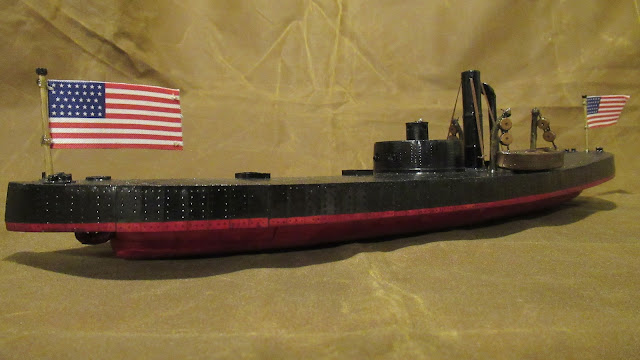
USRC Naugatuck, which was attached to the United States Revenue Marine, was an ironclad that served alongside USS Galena and USS Monitor during the American Civil War. Captain David C. Constable, while he held the rank of First Lieutenant, commanded the revenue-cutter while it provided assistance to the United States Army and the United States Navy. Sewell's Point, in the April of 1862, was bombarded by the United States Navy and by the United States Revenue-cutter Service. USRC Naugatuck, during the Bombardment of Sewell's Point, was engaged in an armed confrontation with CSS Virginia but it appears that two fighting vessels did not launch their projectiles at one another. A second meeting of CSS Virginia and USRC Naugatuck, which occurred in the May of 1862, resulted in an exchange of fire between the ironclads. USRC Naugatuck, according to James Fowler Rusling, was equipped with a gun that fired 250-pound projectiles while Mark Trafton claimed that the revenue-cutter was armed with a gun which launched 200-pound missiles. Other sources, however, maintain that the ironclad was armed with a 100-pounder Parrott rifle. Fort Darling, in the third week of May, was bombarded by the revenue cutter and four gunboats. USRC Naugatuck, on either the first or the eighth discharge, lost the use of its gun during the course of the engagement. Professor Daniel Treadwell influenced the design of the 100-pounder Parrott rifle, with which the revenue-cutter was armed, but his research into the manufacture of ordnance which could withstand high gaseous pressures did not prevent the gun from bursting during the engagement. Parrott rifles fired elongated, conical projectiles that were cast from steel and which resembled acorns. It is suspected that the revenue-cutter lost the use of its gun, which was exposed to the elements, because it was raining. The ironclad, in addition to its heavy rifle, was armed with a pair of smaller guns that were installed in a broadside arrangement.
1) A Concise History of the War. Designated to Accompany Perrine's New War Map of the Southern States, with an Introduction and Statistical Appendix, Compiled from Authentic Sources. by Capt. John S. Bishop.
Captain John Soast Bishop, on page 57 of A Concise History of the War, claims that a detachment of ironclads and unprotected gunboats engaged Fort Darling in the third week of May. It is reported that the State of Virginia, during the second second quarter of 1862, was in the process of being invaded by the armed forces of the United States of America. On the 15th of May, 1862, two armed confrontations are claimed to have occurred in Virginia. Loudon, which is reported to have been situated in Virginia, is claimed to have been the site of a skirmish between the Confederate States Army and the United States Army. A detachment of seventeen men, who are reported to have been serving under General John White Geary, are claimed to have been guarding a consignment of stores that belonged to their Company. It is reported that a force of cavalry, which is claimed to have consisted of between three-hundred and six-hundred horsemen, raided the depot. A brief struggle, in which one of the guards is claimed to have fallen, is reported to have resulted in a victory for the Confederate States Army. It is claimed that the cavalry, after the main body of the Company appeared, retreated and it is reported that they took fourteen prisoners. Fort Darling, on the same day as the skirmish at Loudon, is claimed to have repulsed the three ironclads and two wooden fighting vessels. USS Aroostook, USS Galena, USS Monitor, USRC Naugatuck and USS Port Royal are identified as the men-of-war that exchanged fire with Fort Darling. It is reported that a 100-pounder Parrott rifle, which is claimed to have formed the main armament of USRC Naugatuck, exploded while its first shot was being fired. A great excitement, as a result of the news that the Army of the Potomac was advancing upon Richmond, is reported to have seized the denizens of the capital of Virginia and of the Southern Confederacy. USRC Naugatuck, by engaging Fort Darling, contributed to the scenes of excitement that engulfed Richmond.
2) Annual Report of the American Institute, of the City of New York, for the Years 1861, '62. by the American Institute.
Annual Report of the American Institute, of the City of New York, for the Years 1861, '62 contains a discussion about the developments in naval technology that had occurred during the course of the nineteenth-century. A transcript of a discussion about the evolution of navel warfare, which includes four individuals, contains information about the origins of ironclads and of explosive projectiles. Misters Babcock, Dibben, Joy and Renwick are identified as the experts who discussed the development of armour as well as ordnance. Dibben, to use a direct quote from the article, opened the discussion by delivering a sketch-of the history of iron-plated ships. John Stevens, on page 553, is reported to have been the first inventor to suggested the idea of constructing iron-cased fighting vessels while Robert L. Stevens is credited with the invention of elongated projectiles. Babcock, who describes USRC Naugatuck as Stevens's little boat, claims that the revenue-cutter had been equipped with a 100-pounder Parrott gun that fired steel projectiles. It is reported that the steel shot, which is claimed to have been prepared by the government of the United States of America, were intended by be used against CSS Merrimac in a potential future engagement. USRC Naugatuck, whose gun is reported to have fired projectiles that were shaped like acorns and which were fashioned from solid cast steel, is claimed to have been expected to inflict damage upon the iron plates which protected the man-of-war. It is suggested that the 100-pound Parrott projectiles, if they did not perforate the iron casing of CSS Merrimac, would became embedded within the metal plates and dislodge them. No mention is made, however, of the ability of USRC Naugatuck to resist the missiles of its adversary. CSS Merrimac, according to Babcock, was equipped with guns that could fire 360-pound projectiles. It is implied, therefore, that CSS Merrimac and USRC Naugatuck would have fired a similar weight of shot at one another.
3) Confederate Veteran. Vol. II. by Various Authors.
Hardin Beverley Littlepage, on page 86 of the second volume of Confederate Veteran, claims that he had served onboard CSS Merrimac during the entirety of its career. On the 8th and 9th of March, 1862, the iron-cased ram is reported to have clashed with the men-of-war that were blockading Hampton Roads. USS Cumberland and USS Congress, on the first day of the battle, are claimed to have been destroyed by CSS Merrimac while USS Monitor is reported to have fought the iron-cased ram on the second day of the engagement. On the 11th of April, 1862, CSS Merrimac is claimed to have returned to Hampton Roads with its tenders. It is claimed that the ironclad, in an attempt provoke USS Monitor and USRC Naugatuck into a fight, sent two of its tenders to capture three transport-vessels. USS Monitor and USRC Naugatuck, on the 8th of March, are reported to have bombarded the battery that the Confederate States Army had established at Sewell's Point. It is claimed that USS Dacotah, USS San Jacinto, USS Seminole and USS Susquehanna provided supporting fire to the ironclads. CSS Merrimac, to paraphrase Littlepage, regarded the bombardment of Sewell's Point as an invitation to come out and fight. It is reported that USS Asago, USS Baltimore, USS Cayuga, USS Illinois, USS Jamestown, USS Saint Lawrence and USS Vanderbilt had gathered behind the attacking squadron. All of the fighting vessels, which may have included the attacking squadron as well as the reserve squadron, are claimed to have withdrawn beneath the guns of Fortress Monroe. Fort Wool, which is also referred to as the Rip Raps, is reported to have fired at CSS Merrimac as it approached the fighting vessels. Littlepage, therefore, had had been onboard CSS Merrimack during the engagements of 11th of April and the 8th of May. USRC Naugatuck, on both of these occasions, had been stationed at Hampton Roads and had either exchanged fire with CSS Merrimac or had faced the prospect of engaging the iron-cased ram in an armed contest.
4) Great Guns. The Cause of their Failure, and the True Method of Constructing Them. by Norman Wiard.
Norman Wiard, on page 10 of Great Guns, describes the difficulties that were experienced by those who sought to create guns that were capable of withstanding high pressures of gunpowder gasses. Welding large masses of wrought-iron or steel, however, is claimed to have been beyond the capabilities of the ordnance officers who served in the middle of the nineteenth-century. Professor Daniel Treadwell, who is identified as a denizen of Massachusetts, is reported to have invented a method of constructing barrels that could endure enormous pressures of propellent gasses. Guns which are manufactured from wrought-iron or steel, rather than cast-iron, are claimed to have been able to withstand the detonation of heavier charges of gunpowder. It is implied, however, that the theory of constructing guns that could resist high pressures of gunpowder gas was difficult to put into practice. Treadwell is reported to have influenced the design of the 100-pounder Parrott gun, which is claimed to have been rifled, but criticism is levelled at the process by which the weapon was manufactured. It is reported that the 100-Parrott rifle that formed the main armament of USRC Naugatuck, which is claimed to have been afloat on the James River, exploded within range of Fort Darling. Wiard, on page 46, attempts to determine the reason that the ironclad lost the use of its gun. USS Galena, which is reported to have been armed with similar guns to that which was installed on the open deck on USRC Naugatuck, is claimed to have housed its battery in an enclosed environment. It is reported that USS Galena, during the engagement on the James River, did not lose any of its guns. USRC Naugatuck, whose rifle is claimed to have been subjected to cold and wet conditions, is reported to have lost its gun because of the environmental conditions that it was exposed to. It is argued that the rifle burst due to its exposure to the rain, which cooled the metal, and because of fluctuations in the ambient temperature.
5) Men and Things I Saw in Civil War Days by James F. Rusling, A.M., LL.D. Brigadier General (by Brevet) United States Volunteers.
James Fowler Rusling, on page 238 of Men and Things I Saw in Civil War Days, describes the circumstances in which he was hospitalized during the Siege of Yorktown. On the 13th of April, 1862, Rusling claimed that he had been committed to the United States Hospital. It is reported that the United States Hospital, which is described as a two-story building that was capable of accommodating five-hundred patients, was situated in the Hygeia Hotel. Rusling, on page 239, describes an incident in which CSS Merrimac appeared within the vicinity of Newport News. CSS Jamestown, CSS Yorktown and a dozen tugs are claimed to have accompanied the ironclad on its expedition. It is reported that the ironclad as well as its consorts captured three schooners, which are compared to canal boats, and towed them to Norfolk. Rusling, who states that he had observed the event from the roof of the hospital, was an eye-witness to the activities that unfolded on that day. CSS Merrimac, on page 240, is claimed to have been opposed by two ironclads and a cotton-clad ram. It is reported that USS Monitor and USRC Naugatuck, which is referred to as Stevens's Battery, awaited for the arrival of CSS Merrimac in a stream while it is explained that USS Vanderbilt intended to ram the ironclad. CSS Merrimac is claimed to have fired a shot at USS Naugatuck, which is described as being no bigger than a scow, but the projectile is reported to have missed its target. It is claimed that USRC Naugatuck, in reply to CSS Merrimac, fired a 250-pound projectile at its adversary. USRC Naugatuck, after a delay of two-minutes, is reported to have fired another missile at CSS Merrimac that struck the water within twenty-yards of its target. CSS Merrimac, for reasons that are not explained, is claimed to have to have departed from the scene. It is reported, on page 241, that the armed forces of the United States of America were confident that USS Monitor and USRC Naugatuck could have defeated CSS Merrimac in an open battle.
6) Papers of the Military Historical Society of Massachusetts, Volume I. Campaigns in Virginia, 1861-1862. edited by Theodore F. Dwight.
Theodore Frelinghuysen Dwight, on page 115 of the first volume of Papers of the Military Historical Society of Massachusetts, claims that Fort Darling was attacked by five gunboats that had ascended the James River. Fort Darling, at the time of the bombardment, appears to have been occupied by the Confederate States Army while the United States Navy may be regarded as the custodian of the fighting vessels. On the 15th of May, 1862, three ironclads and two unprotected gunboats are reported to have attacked the fortified battery. It is claimed that Yorktown and Norfolk, prior to the bombardment of Fort Darling, had been evacuated by the armed forces of the Confederate States of America. USS Galena, USS Monitor and USRC Naugatuck are identified as the three ironclads that attacked Fort Darling. It is reported that USS Aroostook and USS Port Royal, which are claimed to have been unprotected gunboats, accompanied the ironclads on the riverine expedition. Extensive damage is reported to have been inflicted on USS Galena, which is claimed to have expended its supply of ammunition, during the battle. USRC Naugatuck, whose 100-pounder gun is claimed to have burst during the engagement, would have been unable to continue to exchange of fire with the opposing batteries. It is reported that the combined firepower of the gunboats was unable to reduce the earthworks, subdue the garrison or silence the guns of Fort Darling. Lieutenant-commander William Nicholson Jeffers, who is claimed to have commanded USS Monitor during the armed confrontation, is quoted as saying that the low rate of fire of the gunboats was responsible for their failure to defeat their adversaries. Fort Darling, according to Jeffers, could not be reduced without the assistance of land batteries. No information is provided about the damage that was inflicted upon USRC Naugatuck by the opposing batteries, the amount of projectiles that it fired during the engagement or if any of its missiles found their target.
7) Scenes in my Life: Occurring During a Ministry of Nearly Half a Century in the Methodist Episcopal Church. by Rev. Mark Trafton, D. D.
Mark Trafton, who dedicates a chapter of Scenes in My Life: Occurring During a Ministry of Nearly Half a Century in the Methodist Episcopal Church to his experiences of the second year of the War of the Rebellion, describes the invasion of the State of Virginia by the armed forces of the United States of America. General John Ellis Wool, on page 316, is reported to have informed Trafton that CSS Merrimac was leaving Norfolk. It is suggested, furthermore, that the ironclad would attempt to get to sea. Wool, according to Trafton, believed that the ironclad would enter the York River and attack the army of General George Brinton McClellan. Fortress Monroe and a shore battery, which is claimed to have been equipped with two 500-pounder guns, are reported to have blocked the path of the ironclad. A gun shot, on page 117, is claimed to have announced the appearance of CSS Merrimac while Trafton was eating his breakfast. It is reported that the ironclad, as it approached Sewall's Point, appeared as a plume of black smoke on the horizon. USS Monitor, whose commanding officer is claimed to have been roused from his hospital bed by the alarm shot, and USS Vanderbilt are reported to have awaited the approach of their adversary. It is explained, on page 319, that USRC Naugatuck had arrived within the vicinity of Fortress Monroe on the previous day. CSS Merrimac, therefore, faced the prospect of fighting two ironclads and an iron-beaked ram. It is claimed that USRC Naugatuck, which is described as Stevens's famous boat, was prepared to support the Federal gunboats. Trafton, on page 320, describes the moment in which USRC Naugatuck launched a 200-pound projectile at its opponent. It is reported that a second shot, which could have caused an international incident with the Empire of France, landed within twenty-feet of a French frigate. CSS Merrimac is reported to have fired two projectiles at USRC Naugatuck, neither of which is claimed to have hit their target, before it returned to its moorings at Norfolk.
8) The Internal Revenue Record and Customs Journal by Various Authors.
Captain David C. Constable, on page 321 of the thirty-fourth volume of Internal Revenue Record and Customs Journal, is identified an an officer of the United States Revenue Marine. It is reported that Constable, who is claimed to have entered the United States Revenue-cutter Service in 1852, had an excellent war record. On the 15th of May, 1862, Constable is reported to have been promoted to the rank of Captain. Constable, in the years that preceded the outbreak of the American Civil War, is claimed to have served onboard USRC Harriet Lane during the Paraguay Expedition. USRC Naugatuck, which is described as a submerged battery and as a revenue-cutter, is reported to have participated in the engagement with the batteries of Fort Darling. Constable, at the time in which he commanded the ironclad, is claimed to have held the rank of First Lieutenant. Abraham Lincoln, who is reported to have served as the President of the United States of America during the War of the Rebellion, is claimed to have promoted Constable to the rank of Captain. It is reported that Constable, whose conduct is described as meritorious, was promoted due to his actions at the Battle of Fort Darling. No other officer of the United States Revenue Marine, to paraphrase the author of the obituary, was commissioned as a Captain by Lincoln. Constable, after he had been relieved of the command of USRC Naugatuck, is claimed to have been appointed to the role of assistant superintendent of construction. It may be presumed, due to the branch of government to which Constable belonged, that the mariner oversaw the construction of revenue-cutters for the Treasury Department. An undisclosed number of steamers, which are reported to have been of a fine quality, are claimed to have been built under the supervision of the revenue officer. Constable, who is reported to have commanded many revenue-cutters at a variety of stations, is described as a careful as well as a painstaking officer.
9) The Rebellion Record: A Diary of American Events, with Documents, Narratives, Illustrative Incidents, Poetry, Etc. Fifth Volume. edited by Frank Moore, Author of "Diary of the American Revolution."
Frank Moore, on page 5 of the fifth volume of The Rebellion Record, describes an incident in which Abraham Lincoln and Edwin Stanton observed a pair of ironclads exchanging fire with an undisclosed number of land batteries. On the 8th of May, 1862, USS Monitor and USRC Naugatuck are reported to have bombarded the batteries that were situated on Sewell's Point as well as Craney Island. CSS Merrimac, during the course of the engagement, is reported to have appeared at one of the entrances of Hampton Roads but is claimed to have been disinclined to fight the opposing ironclads. It is claimed that USRC Naugatuck and USS Monitor, in their turn, did not seek a direct confrontation with the iron-cased ram. USRC Naugatuck, on page 15, is identified as one of five fighting vessels that were repulsed by Fort Darling. It is reported, on page 44, that the armed forces of the Southern Confederacy abandoned Norfolk in the second week of May. On the 11th of May, 1862, USRC Naugatuck and USS Monitor are claimed to have been moored in front of Fort Norfolk. Commodore Josiah Tattnall, whose account of the destruction of CSS Merrimac appears on page 46, describes the bombardment of Sewell's Point by six gunboats. It is reported that USRC Naugatuck, USS Monitor and five unprotected fighting vessels shelled the batteries on the 8th of May. CSS Merrimac, which Tattnall refers to as CSS Virginia, is reported to have guarded the battery that had been established at Sewell's Point. It is reported, on page 122, that USRC Naugatuck shelled Pig Point Battery. Commander John Rodgers, on page 133, describes the moment in which USRC Naugatuck lost its 100-pounder Parrott rifle. Constable, on the 16th of May, informed Rodgers that USRC Naugatuck had used its light broadside guns to suppress the musket-fire that had been directed at it with shells and canister-shot. James Wilson and Peter Dixon, according to Assistant Surgeon Ransford E. Van Gieson, were injured while serving onboard the revenue-cutter.
10) The Siege of Richmond: A Narrative of the Military Operations of Major-general George B. McClellan during the Months of May and June, 1862. by Joel Cook, Special Correspondent of the Philadelphia Press with the Army of the Potomac.
Joel Cook, who dedicates the fifth chapter of The Siege of Richmond to the stalled advance on the capital of the Southern Confederacy, describes the combined operations that occurred on the James River. John Letcher, on pages 103 and 104, is reported to have been the Governor of the Commonwealth of Virginia at the time in which Major-general George Brinton McClellan was advancing on its capital. It is claimed that the General Assembly of Virginia, in concurrence with the Governor, determined to defend Richmond at all costs. Joseph Mayo, who is reported to have been a descendent of the founder of the city, is claimed to have been the Mayor of the capital of the Confederate States of America. CSS Merrimac, on page 111 as well as page 112, is reported to have been scuttled in the second week of May. It is claimed that the destruction of the ironclad, which blocked the path of Federal gunboats and transport vessels, made it possible for the United States Navy to ascend the James River. Commodore Louis Malesherbes Goldsborough is identified as the commander of the naval squadron, whose advanced division is reported to have included USRC Naugatuck, that was approaching Richmond. Commander John Rodgers is claimed to have been placed in command of the advanced division while Fort Darling, which is described as a celebrated earth-work as well as a heavy battery, is reported to have blocked the path of the gunboats. On the 17th of May, 1862, the advanced division is claimed to have exchanged fire with Fort Darling. USS Galena, USRC Naugatuck and USS Monitor are identified as the ironclads that fought the battery. It is claimed that USRC Naugatuck, whose rifled gun is reported to have burst on its eighth discharge, resisted all of the projectiles that Fort Darling hurled in is direction. A total of five casualties, including two mariners who lost their lives and three crew members who were injured, are reported to have been sustained onboard the ironclad after the gun burst.
On the 9th of August, 2026, the blogpost was updated.

Comments
Post a Comment